In 2023, a coalition of 200 cities across 50 countries committed over $150 billion to smart city initiatives, according to the International Data Corporation. The investments span 5G networks, IoT-enabled traffic management, AI-powered waste collection, and digital citizen portals.
One category of urban activity, however, remains stubbornly analog: the physical inspection.
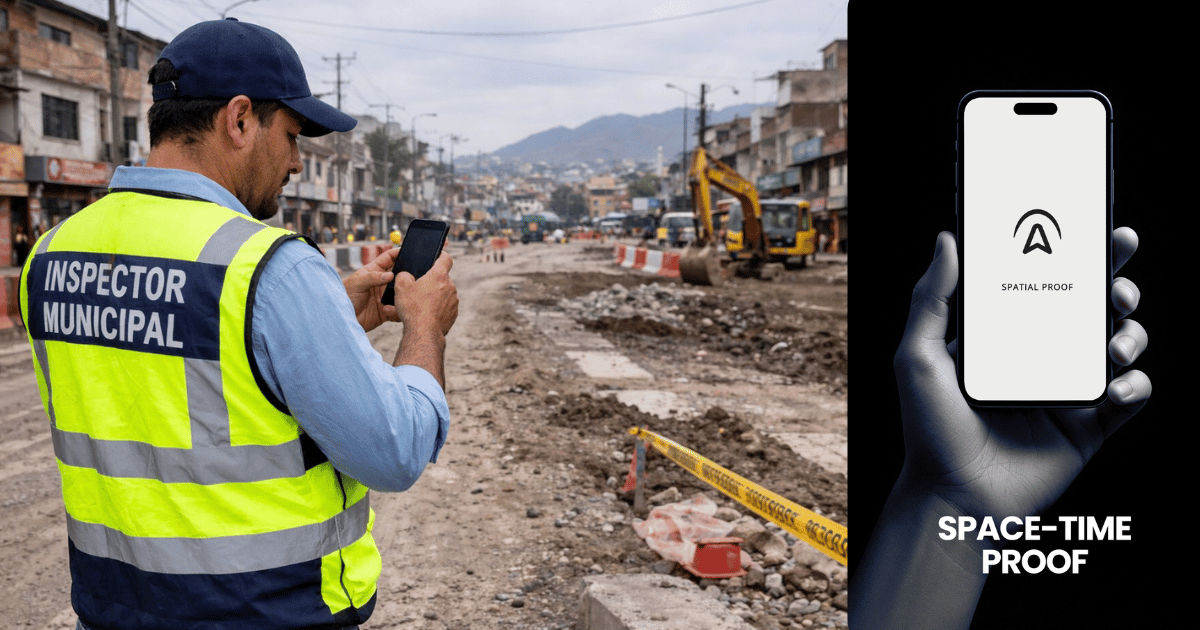
Every day, thousands of municipal inspectors across Latin America, Southeast Asia, Africa, and Southern Europe are dispatched to verify public works progress, assess road conditions, confirm street lighting maintenance, and evaluate post-disaster damage. The tools most of them carry are the same ones available a decade ago: a smartphone with a standard camera, a paper checklist, and the assumption that whatever they report is true.
The Accountability Gap Nobody Is Talking About
The smart city conversation focuses heavily on connectivity, data analytics, and citizen services. What it rarely addresses is a more fundamental question: how do cities verify that physical work was done?
Consider the lifecycle of a typical municipal public works contract. A city government approves funding for road repairs, hires a contractor, and assigns inspectors to verify progress. The inspector drives to the site, takes photos, fills out a form, and submits the report. Payment is authorized.
The problem is that nearly every element of this process can be falsified.
GPS coordinates can be spoofed using free applications available on any app store. Photos can be taken at a different location or time and submitted as current evidence. Timestamps can be manipulated. Inspection forms can be completed from an office rather than the field. According to Brazil's Federal Court of Accounts (TCU), an estimated 20-30% of public works contracts contain irregularities. The World Bank has documented similar patterns across developing nations, where weak verification systems enable what auditors call "phantom projects" that exist only on paper.
How GPS Spoofing Undermines Municipal Verification
The most common vulnerability in current inspection workflows is GPS spoofing. A study published by the European Union Agency for Cybersecurity (ENISA) in 2024 documented over 900,000 GPS spoofing incidents globally, a figure that has grown 400% since 2020.
For municipal fraud, the mechanics are straightforward. An inspector or contractor downloads a GPS spoofing app, sets a false location matching the inspection site, takes a photo from anywhere, and submits it as field evidence. The municipality's system records the falsified coordinates as genuine. Payment proceeds.
The cost of committing this type of fraud is effectively zero. The cost of detecting it through traditional auditing, which involves sending a second team to the site, cross-referencing records, and interviewing witnesses, can exceed $50,000 per investigation.
This asymmetry is what makes public works fraud so persistent. It is cheap to commit and expensive to detect.
Smart Street Lighting: A Case Study in Verification Failure
Street lighting maintenance is one of the most fraud-prone municipal contracts worldwide. Cities maintain hundreds of thousands of lighting points. Curitiba, Brazil, maintains approximately 120,000. Florianopolis manages around 60,000. Mexico City has over 300,000.
Maintenance contracts typically pay per unit replaced or repaired. A contractor reports replacing 500 lamps in a month. The city pays for 500. But without field verification, there is no reliable way to confirm that 500 lamps were actually replaced, that the correct lamps were installed, or that the work was done at the reported locations.
Multiply this across every city in Latin America maintaining public lighting contracts, and the potential for unverified claims becomes substantial.
The irony is telling. These same cities install "smart" lighting systems with IoT sensors and remote monitoring. Yet the maintenance verification for those systems still depends on unverified human reporting.
What Cryptographic Field Verification Looks Like
A growing number of organizations are building what might be called the verification layer for physical-world activities. The approach differs fundamentally from traditional auditing.
Rather than verifying after the fact, these systems capture multiple independent verification signals at the moment of field activity. A platform like Spatial Proof, which won the $100,000 DPI Challenge backed by the Gates Foundation, Boston Consulting Group, and JICA (placing in the top 5 among 540 organizations from 73 countries), captures 50+ data points per field event using standard smartphones.
The verification signals include GPS coordinates cross-referenced with anti-spoofing algorithms, camera authentication that detects emulation software, cryptographic hashing (SHA-256) applied at the moment of capture, atmospheric and weather data from satellite systems matched against the claimed timestamp, barometric pressure, ambient light levels, accelerometer readings, and AI-powered scene analysis that evaluates whether the captured image matches the claimed activity.
No single signal is conclusive on its own. But faking all eight layers simultaneously requires a level of sophistication that eliminates casual fraud, according to the company's technical documentation.
Why Offline Capability Changes the Equation
One of the most overlooked requirements for municipal verification in developing regions is connectivity. Many of the areas where inspections matter most, such as peripheral neighborhoods, rural roads, and post-disaster zones, have limited or no mobile data coverage.
Any verification system that requires an internet connection to function effectively abandons the locations where fraud is most likely to occur. Field inspectors in remote areas of southern Brazil, for example, routinely operate in zones with intermittent coverage.
Offline-first architecture, where the verification device captures and cryptographically secures all data locally before syncing when connectivity returns, addresses this gap. It is a technical requirement that few platforms meet, but one that determines whether verification works in practice or only in theory.
The Municipal Governance Opportunity
For city governments, the value proposition extends beyond fraud prevention. Cryptographic field verification creates a complete audit trail for every inspection, maintenance activity, and compliance check. This data can inform better procurement decisions, identify underperforming contractors, and provide citizens with transparent evidence of how public money is spent.
Cities that have invested heavily in digital transformation, such as Curitiba (named "World's Smartest City" at the 2023 Smart City Expo World Congress, with 73% digital adoption among residents) and Florianopolis (ranked the number one Connected Smart City in Brazil by the Urban Systems consultancy, home to over 1,400 technology companies), represent ideal candidates for this next layer of digital governance.
These cities already have the digital infrastructure, the political will for innovation, and the institutional capacity to adopt verification technology. What they lack is the specific tool that bridges the gap between their digital systems and the physical activities those systems are meant to govern.
The Broader Smart City Implication
The verification gap is not unique to any single country or region. According to a 2024 McKinsey Global Institute report, cities worldwide could unlock $1.7 trillion in annual value through smart city technologies, but only if the data underlying those technologies is trustworthy.
This is where field verification intersects with the broader Digital Public Infrastructure movement. DPI systems like India's UPI (processing 12+ billion monthly transactions) and Brazil's Pix (serving 150+ million users) have proven that digital infrastructure can operate at population scale. But these systems verify digital transactions, not physical activities.
The next evolution of municipal governance requires infrastructure that can verify both: confirming who performed an inspection (digital identity), processing the payment for completed work (digital payments), and proving that the work was actually done at the claimed location and time (field verification).
Technology Is Not a Complete Solution
It would be naive to suggest that verification technology alone can eliminate public works fraud. Institutional reforms, stronger procurement regulations, whistleblower protections, and political will are all necessary components.
Technology provides the evidentiary foundation. It makes fraud harder to commit and easier to detect. But it cannot replace the institutional frameworks that determine whether detected fraud leads to consequences.
The most effective implementations will combine cryptographic verification tools with governance reforms that use the resulting data to hold contractors and officials accountable. Technology without accountability is surveillance. Accountability without technology is aspiration.
What Comes Next
The GovTech market is projected to exceed $30 billion by 2028, according to Deloitte's Government Technology report. Within that market, anti-fraud verification represents one of the fastest-growing segments, driven by regulatory pressure and the increasing availability of smartphone-based solutions that eliminate the need for expensive proprietary hardware.
For smart cities that have already invested billions in digital infrastructure, adding a verification layer for physical activities is not a luxury. It is the logical next step toward governance that citizens can actually trust.
The question is no longer whether cities need to verify field activities. It is whether they will adopt the tools to do so before the next billion dollars flows through unverified inspection reports.
"A government that cannot verify what happens in its own streets will never earn the trust of the people who walk those streets. Transparency is not a dashboard. It is cryptographic proof at the point of action."
Frequently Asked Questions
What is smart city field verification?
Smart city field verification refers to the use of technology, typically smartphone-based platforms with multiple security layers, to confirm that physical-world activities like inspections, maintenance, and compliance checks actually occurred at the reported location and time. Unlike traditional auditing, modern field verification captures cryptographic proof at the moment of activity.
How does GPS spoofing affect municipal inspections?
GPS spoofing allows anyone to fake their reported location using free apps. In municipal inspections, this means an inspector or contractor can report being at a work site while actually being elsewhere. This undermines the entire inspection process and enables fraud in public works contracts estimated at hundreds of billions globally.
Can field verification work without internet connectivity?
Yes. Platforms designed with offline-first architecture capture and encrypt all verification data locally on the device. When connectivity becomes available, the data syncs to servers. This is essential for municipal inspections in areas with limited coverage, which are often the areas where verification is most needed.
How does cryptographic verification differ from traditional auditing?
Traditional auditing verifies after the fact by sending additional personnel to review evidence. Cryptographic verification captures multiple tamper-proof signals (GPS, camera integrity, sensor data, timestamps, atmospheric conditions) at the moment of activity, creating an immutable record that can be independently audited by anyone. It is preventive rather than reactive, and typically costs a fraction of manual auditing.